
%20-%20Grande.jpeg)
Greetings from Lomé, Togo!
As we mentioned in last month’s newsletter, we are still here for our exploration sprint. We flew out 18 members of the Kabakoo team to Lomé, for four weeks. Just to explore. And also because it is the fastest way to replace assumptions with reality.
🎶 Our jam of the month is Neng Makassi by Sam Fan Thomas, a 1985 tune from Cameroon that was a hit from East to West Africa and even in the Afro-Caribbean and Afro-Brazilian/Colombian diaspora. Another song of Sam Fan Thomas was already our tune of the month in our November 2024 update. Since arriving in Lomé, we have heard these songs played in the streets countless times (!). There is something powerful about hearing 40-year-old tracks still moving people across the continent. Maybe a reminder of the real promises of true Pan-Africanism. Not the kind under elite capture… But well, that’s a topic for another day.
What are we building?
Kabakoo designs and scales evidence-based pathways for West African youth, integrating AI, community, and cultural insights to foster the mindset and skills essential for building productive livelihoods and driving systemic change in informally dominated economies.
☀️ November 2025 Highlights
Kabakoo as the blueprint: How our work inspired Togo’s new innovation hub
Here is something that took us completely by surprise: During our meetings at the Université de Lomé, one of West Africa’s largest universities with over 74,000 students, we learned that we were already here before we arrived. Really.
In February 2025, the university inaugurated the Pôle Universitaire d’Innovation et de Technologie, a 1,200 m² innovation and technology hub designed to support student entrepreneurs, artisans, and innovators. The consultancy EY was mandated to design the concept. They benchmarked nine organizations worldwide. According to EY’s report, Kabakoo was the primary source of inspiration. From all nine benchmarked organizations, we are the only one the consultants recommended to draw inspiration from for two distinct stages of development of the new hub.
And here is the surprise in the surprise: we never talked with the EY consultants. They found what they needed through our published materials, our newsletters, our research, our documentation. This tells us something important: when you share your knowledge openly, it travels. It replicates. It inspires without you even knowing.
We believe this is impact, real impact! Impact through openness and dedication to the broader field and the common good. Now a quick question to any funder reading this: how, if at all, do you account for this kind of broad-level impact, i.e. when an organization’s model and ideas start been replicated directly or indirectly?


EY benchmarking Kabakoo for an innovation hub in Togo. (Let's us know, should you want the whole presentation).
Highdigenous knowledge exchange at the Togo Data Lab
We spent a fantastic afternoon at the Togo Data Lab, a partnership between the Government of Togo and CEGA (UC Berkeley) that’s positioning the country as a leader in data science for public policy.
The conversation turned into a 2+ hour session where we shared our experience building language models for Bamanankan with their team, as they are embarking on creating AI products in Ewe, Togo’s major language. Both languages face similar challenges: limited training data, tonal complexity, and the need for culturally-grounded approaches.
We shared, among others, what we have learned via our approach to community-led data collection and the ethics conversations we have navigated with Bamanankan speakers in Mali.
Shout out and gratitude to our Board Member, Temina, and to Carson and Sean from CEGA for the intros; and to Commandant Togbe, Farooq, and Gnouyaro of the Togo Data Lab for the warm welcome, the insightful exchanges and good laughs.


Kabakoo at the Togo Data Lab
Some main updates from our 4 weeks of exploration/expansion sprint
The sprint has been intense and productive:
- Met with the President of the Université de Lomé to discuss potential collaborations
- Held meetings with telco executives about distribution partnerships
- Our product designers spent time on campus talking with students and even making new friends
- Our content colleagues conducted interviews with artisans and craftspeople for upcoming activation materials
We will share more as these conversations develop into concrete partnerships.


Kabakoo in Lomé! 🇹🇬
WhatsApp vs. App: Where are learners actually learning?
As we continue developing our WhatsApp Learning System (WLS), we wanted to understand how learners engage across our different platforms.
Over the past six months, we have seen 2,903 new app learners versus 1,689 new WhatsApp learners. August’s Bamako.ai event created a clear spike with 1,722 new app accounts and 1,239 WhatsApp learners in that month alone.
But there is a nuance: WhatsApp and mobile app are not two separate entry channels. When a WhatsApp learner reaches a level of engagement requiring app-specific features (such as portfolio submission, QR code scanning, course access), their app account is automatically activated. So the gap reflects both direct app registrations and conditional activations triggered by advanced usage of our WhatsApp Learning System.
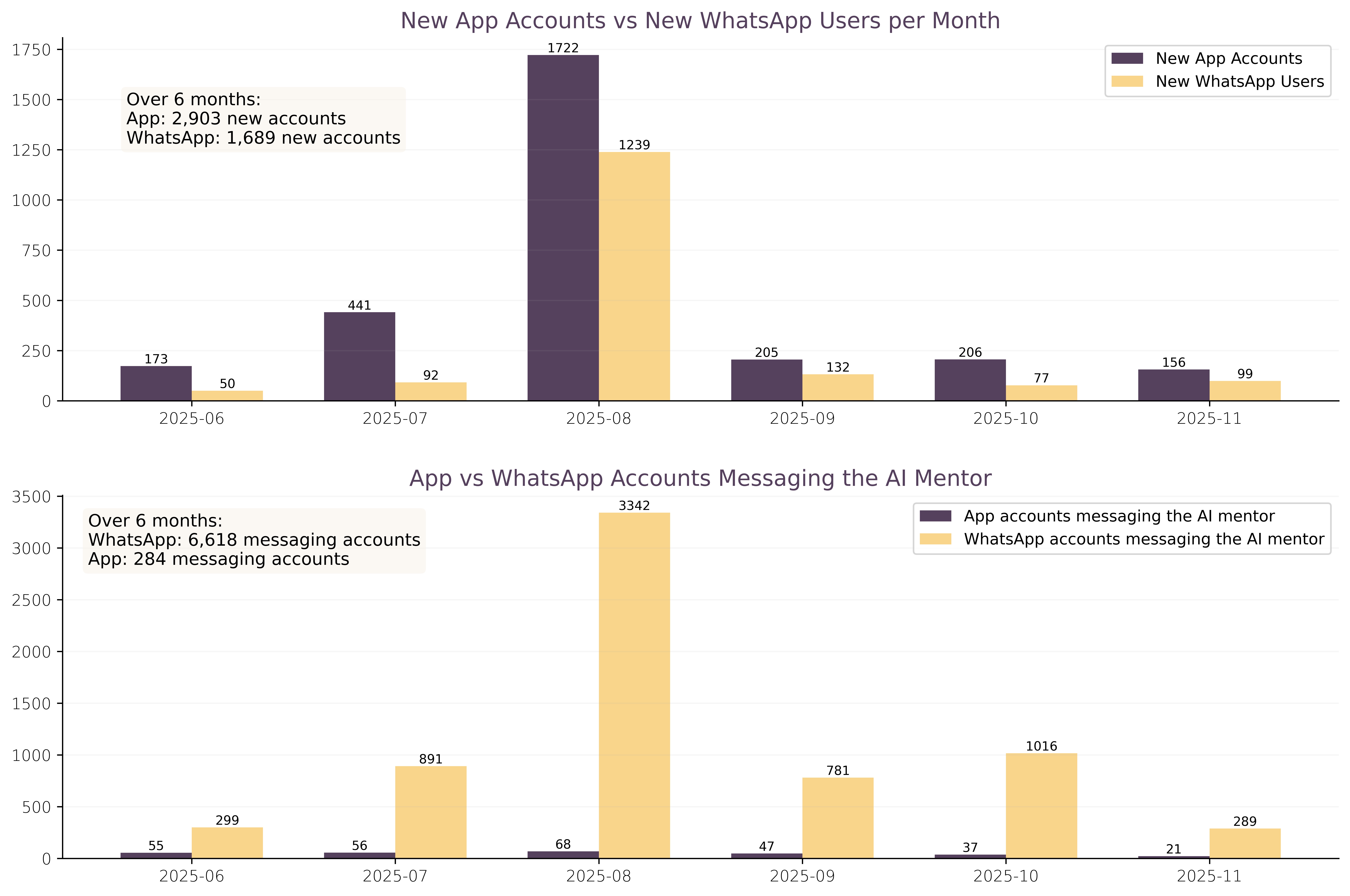
When it comes to conversations with the Kabakoo AI mentor, the picture inverts dramatically. Over six months, more than 6,000 learners exchanged via WhatsApp, compared to approximately 300 via tha app.
The takeaway is clear: learners prefer to meet us where they already are: on WhatsApp. Our job is to make that space as effective for learning as possible.
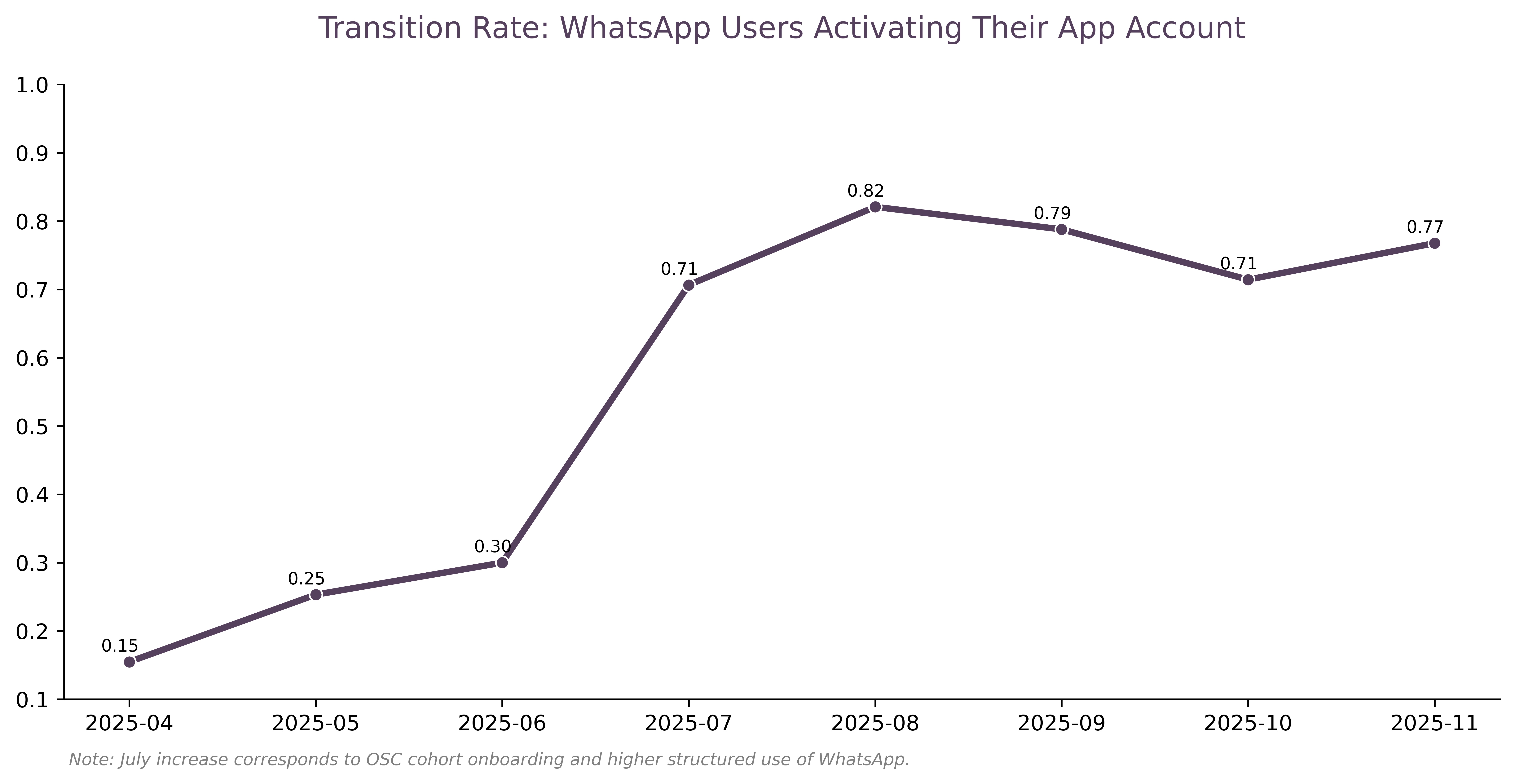
One encouraging signal: the proportion of WhatsApp learners who activate their app accounts has grown from 15% in April to a stable 75-80% by August-November. This means about three out of four WhatsApp learners eventually engage deeply enough to unlock app features. It also reflects our progress since we have decided to be more intentional about the integration of WhatsApp as key tool in our overall upskilling platform.
Smart onboarding: Capturing learner profiles from day one
With the deployment of our new WhatsApp onboarding flow, we now capture learner interests and profiles right from the start of their journey, directly in WhatsApp. This enables more personalized learning experiences.


Screenshots: Surveying learners' interests directly in WhatsApp
As a priority development, we are building AI-powered peer matching. These are automatically forming “pods” (small learner groups) based on complementary interests, skills, and objectives. Early analysis of test groups (n=14, g=3) shows the AI can constitute cohesive, effective pods by identifying synergies between learners. Our hypothesis is that this we strengthen the social capital layer of the Kabakoo Learning Experience. We will share more as we iterate.
A wake-up call from our own neighborhood
Sometimes you need to look at your own backyard with fresh eyes.
We recently conducted a qualitative survey of 100 youth in Missabougou, the Bamako neighborhood where our main co-learning space is located. Missabougou is part of the Commune VI, Bamako’s largest district with approximately 600,000 residents. Our purpose was to establish a baseline before testing a new neighborhood-by-neighborhood distribution strategy. So, we went out and had long (structured) chats with 100 youth!
The findings were humbling.
About 20% of respondents had heard of Kabakoo. We are based here. We have been operating for years. And yet, four out of five young people in our community don’t know we exist.
On the positive side, 67% expressed interest in 3-6 month training programs. So, the appetite might be there. The awareness is not where it could be.
What our neighbors told us:
- WhatsApp is king: 71% use it as their primary source for job and training information. TikTok (15%) and Facebook (8%) trail far behind. This is a solid replication of the results of the national survey (N > 1.3k youth in Mali) we ran last year about trust of youth in people, institutions, and media.
- The grin (informal friend group) matters: 56% of youth hang out at grins after home, and 29% consult their grin for major decisions, second only to family (51%). This is consistent with the success of the grins during the last edition of our flagship event Bamako.ai.
- Trust the success stories: 23% look to “people who made it” (successful older peers who followed similar paths) for guidance.
- CFPM dominates brand recognition: The vocational training center we helped digitize last year is cited by 65% of respondents as the top training reference.
- Time is the main barrier: 31% who hesitated about training cited work or school obligations.
We are now designing a hyperlocal strategy that leverages grins and trusted community touchpoints. We already have a couple of ideas that we are looking forward to implementing. Stay tuned!
Kabakoo Faces
(With 35k+ registered learners, each month we spotlight a member of our vibrant community.)
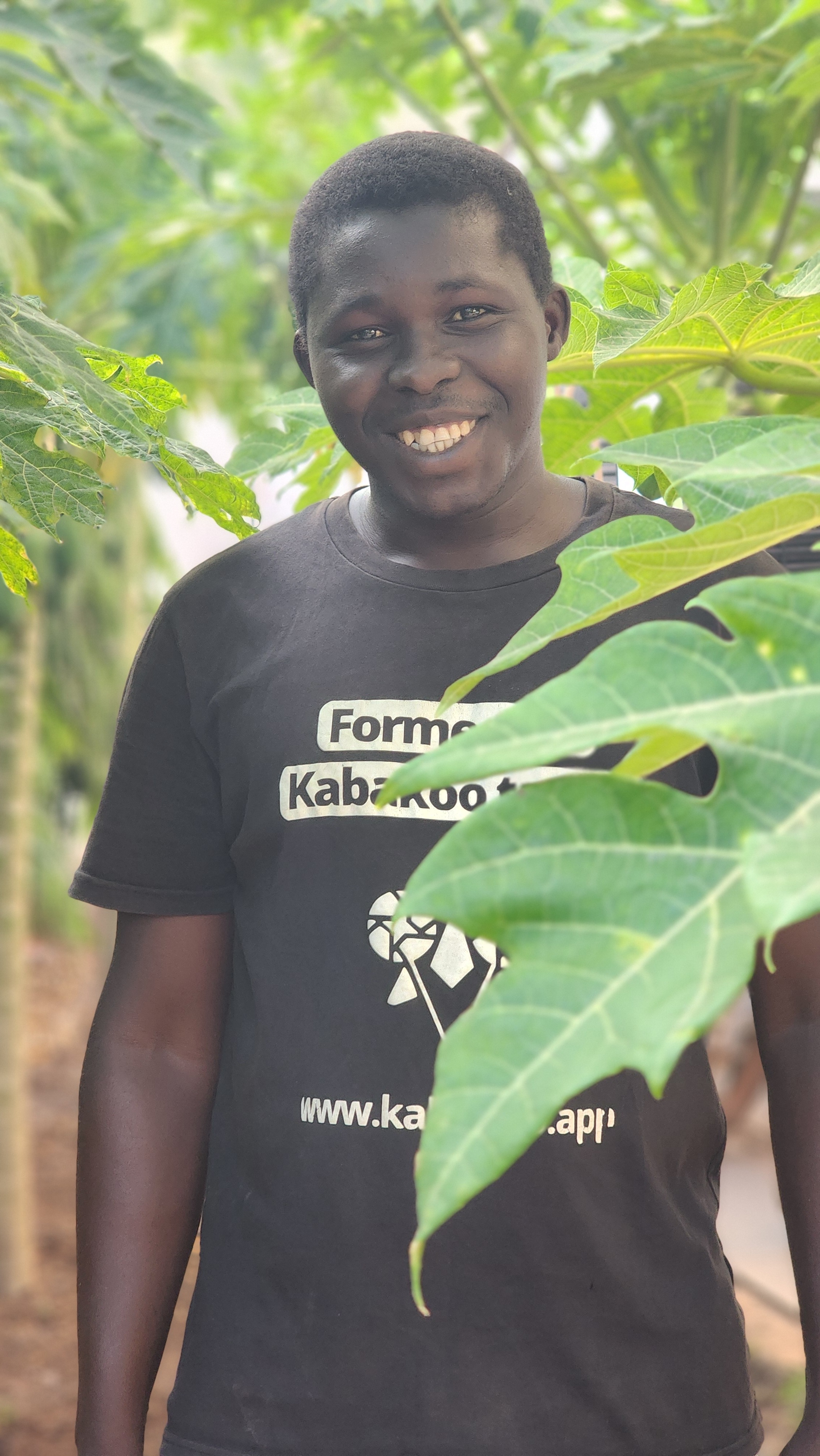
Before joining Kabakoo, Yahaya says he was stuck. He had a degree in agropastoral studies, but in Mali, as he puts it: “When you have a diploma in agriculture or you are a farmer, you are not considered.”
Back in Sikasso, Southern Mali, he would come home from the field and scroll through TikTok, Facebook, and WhatsApp. He didn’t know how to use the internet for research, for learning, for building something. Meanwhile, his former classmates went to artisanal gold mining and came back with money and new motorcycles.
“I saw myself there, diploma in hand, sitting at home without work. People in the street would say, ‘There goes the son of so-and-so, just like that.’ They mocked me.”
But Yahaya refused to go to the mines. He had heard too many sad stories. He wanted work that matched his training.
He later joined Kabakoo though a cohort on regenerative agriculture. He says: “The knowledge I have gained at Kabakoo, I never found anywhere else. My training before and my training now are as different as the water of the river and the fish.”
Today, Yahaya trains other youth in regenerative agriculture, not just in Bamako but in communities across Mali. He provides for himself without depending on anyone. The worry that used to consume him has lifted.
In his own words: “Before Kabakoo, I had too many problems and worries. I sat at home not knowing what to do. Today, my mind is at peace. Thank you, Kabakoo.”
Watch Yahaya tell his story here (link).
Thank you for reading to the end! 💜🧡
Michèle & Yanick


.jpg)


