During the last months, the same idea kept surfacing no matter which dataset we analyzed. People learn through other people. We call it the social brain. In this edition, we look at why the stories of makers and artisans keep travelling further than anything else we publish, what an external analyst found when he went through our engagement numbers, and what 11,171 bilingual conversations with our AI Mentor told us about how learners really use language in AI-powered learning systems.
🎵 🎷 Our jam for this month: At Kabakoo we build with purpose. Steady, advancing, always on the lookout for improving our work. This month the vibe and motion, both fierce and tender from Coltrane, A Love Supreme has guided us. So please clear the noise and have a good read while following us down the next lines… building with purpose.
Kabakoo designs and scales evidence-based pathways for West African youth, integrating AI, community, and cultural insights to foster the mindset and skills essential for achieving economic mobility and driving systemic change in informally dominated economies.
Highdigenous Talks: connecting endogenous knowledges, youth, and economic value creation
During the last months, we’ve watched the same pattern in our youth-facing content. The stories that go furthest are about artisans, makers, and problem-solvers working in their communities. As we argued in our 01/2026 edition, we treat these craftmasters as knowledge holders. And one of our core theses is that these culturally embedded knowledges have a prominent role to play in the fixing up of the human capital production function in the contexts where we operate. So it’s important to understand why these stories travel so consistently well.
When we started Highdigenous Talks, the idea was simple. We wanted learners to meet and engage with experts whose knowledge rarely shows up in a classroom or an innovation hub. The conversations were rich, but we were not satisfied with the attendance numbers. For a while, we were essentially organizing conversations and hoping people would show up. We even had a version where Kabakoo staff would organize workshop visits, as a way to ease the links between the youth and experts grounded in endogenous knowledges.
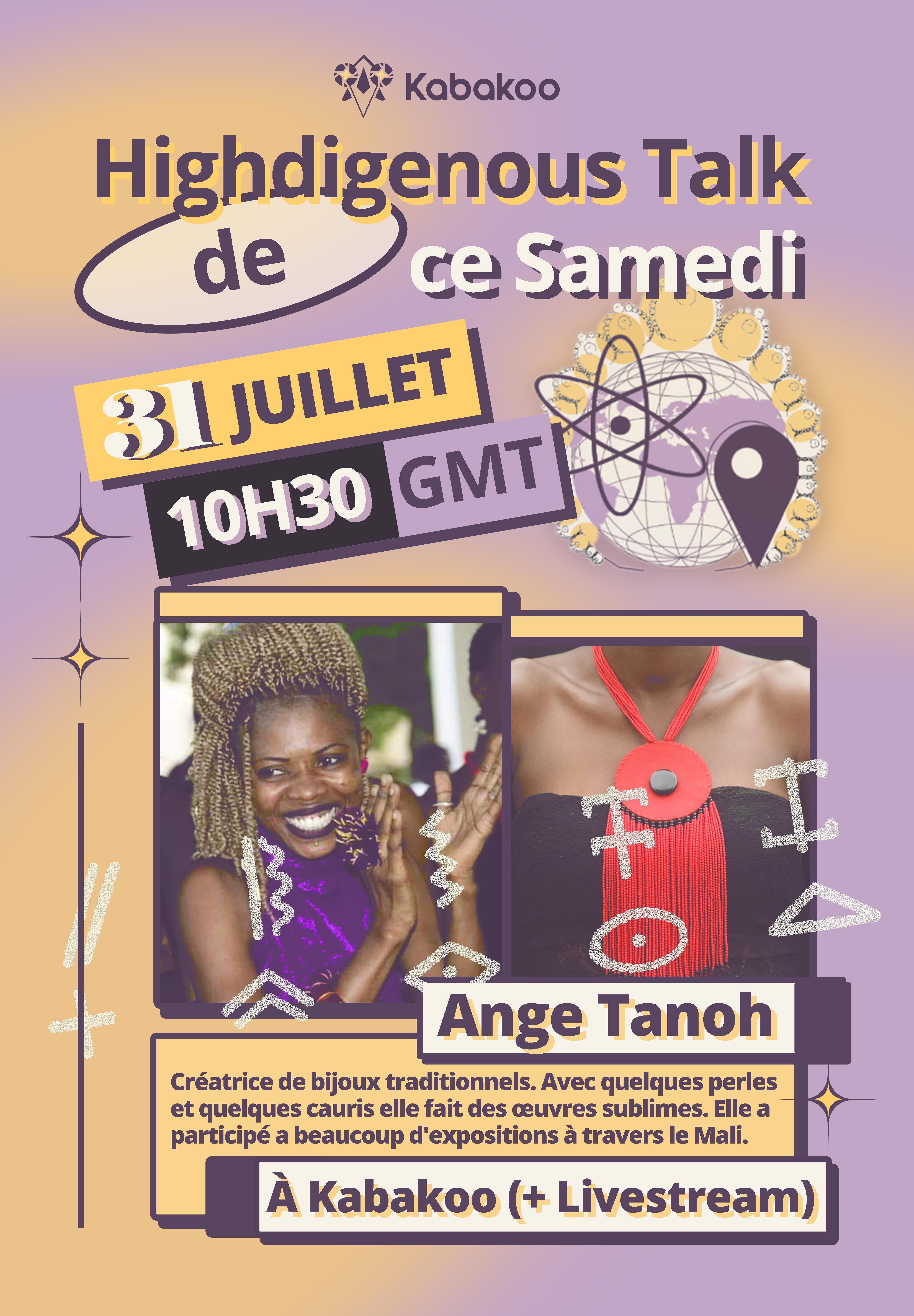
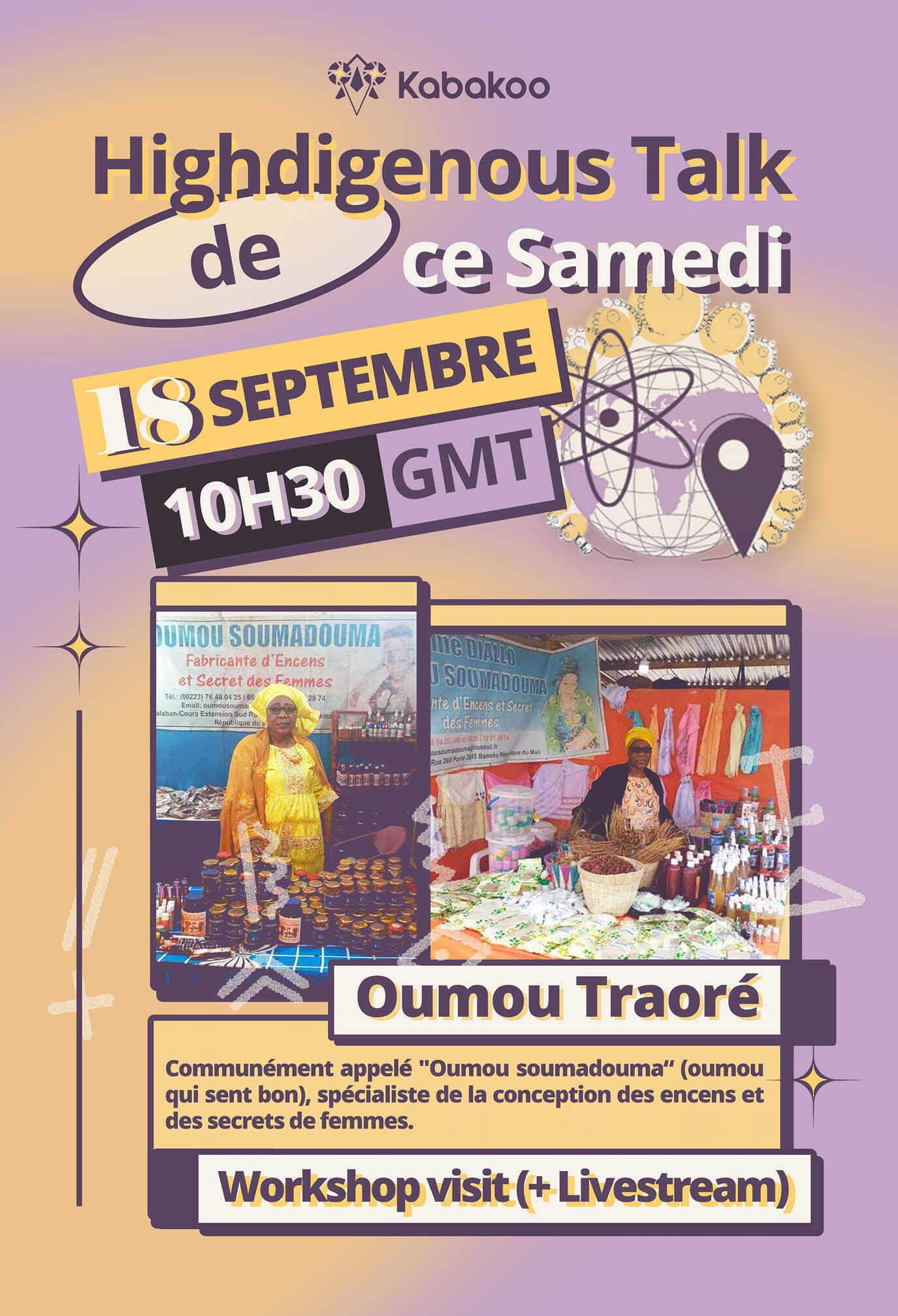
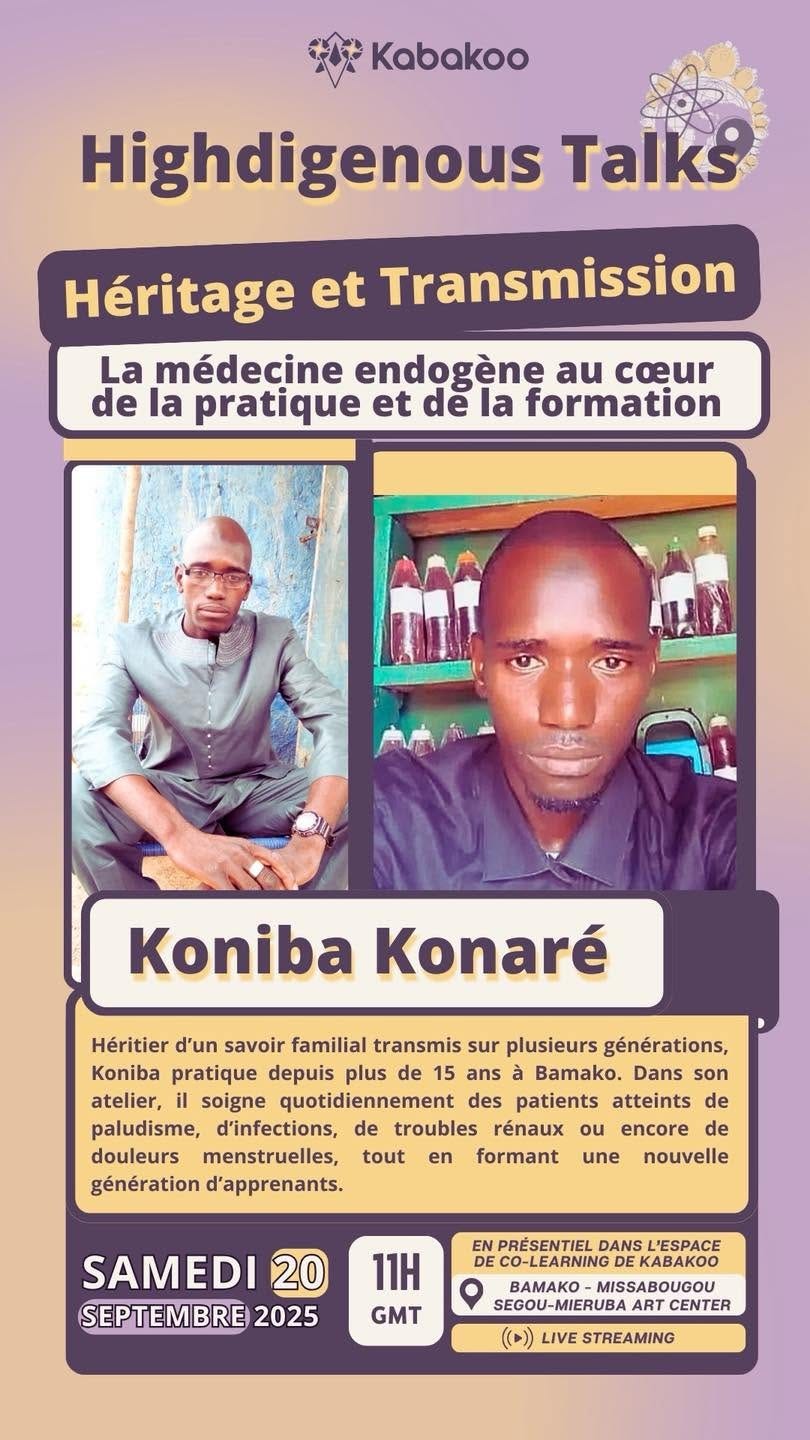
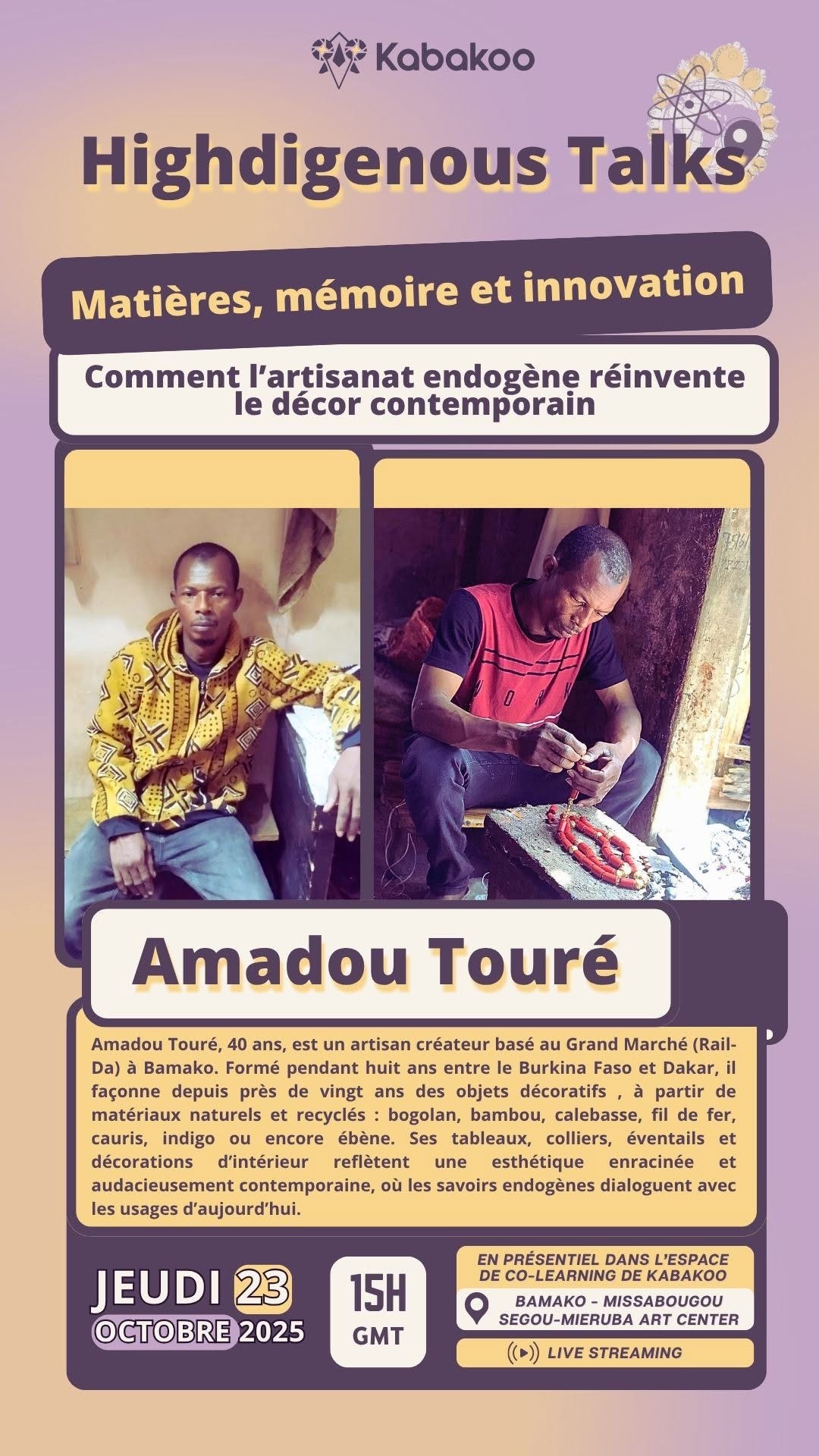
A random selection of previous Highdigenous Talks event posters
After several iterations, we flipped the script. Instead of looking at the Highdigenous Talks as a series of events, we conceptualized them as stories. Who is this person? What have they built? What problems have they spent years learning to solve? Before each talk we began publishing short videos, portraits, and interviews so people could meet the person behind the expertise and bring their questions to WhatsApp or TikTok before anyone walked into a room.
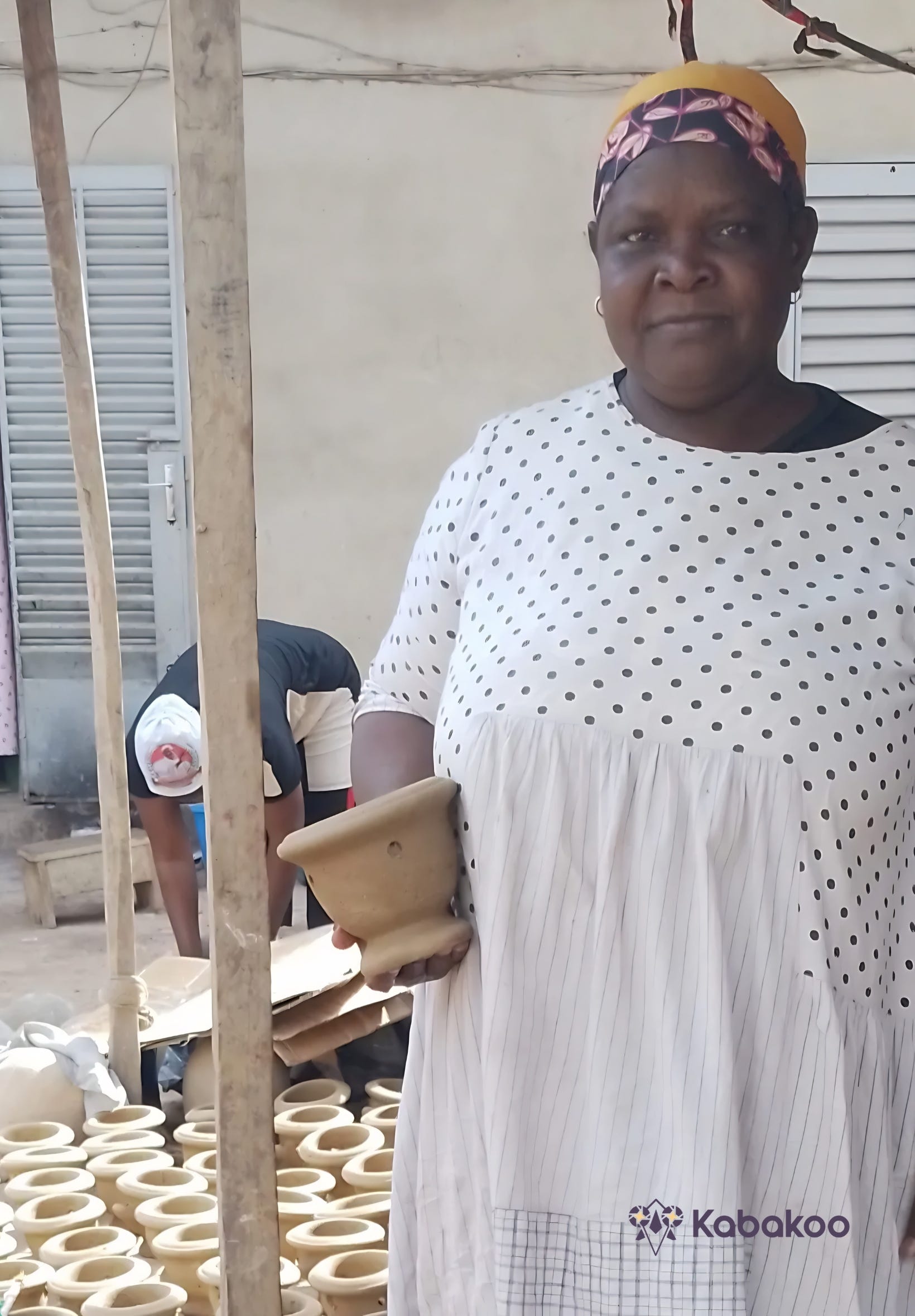
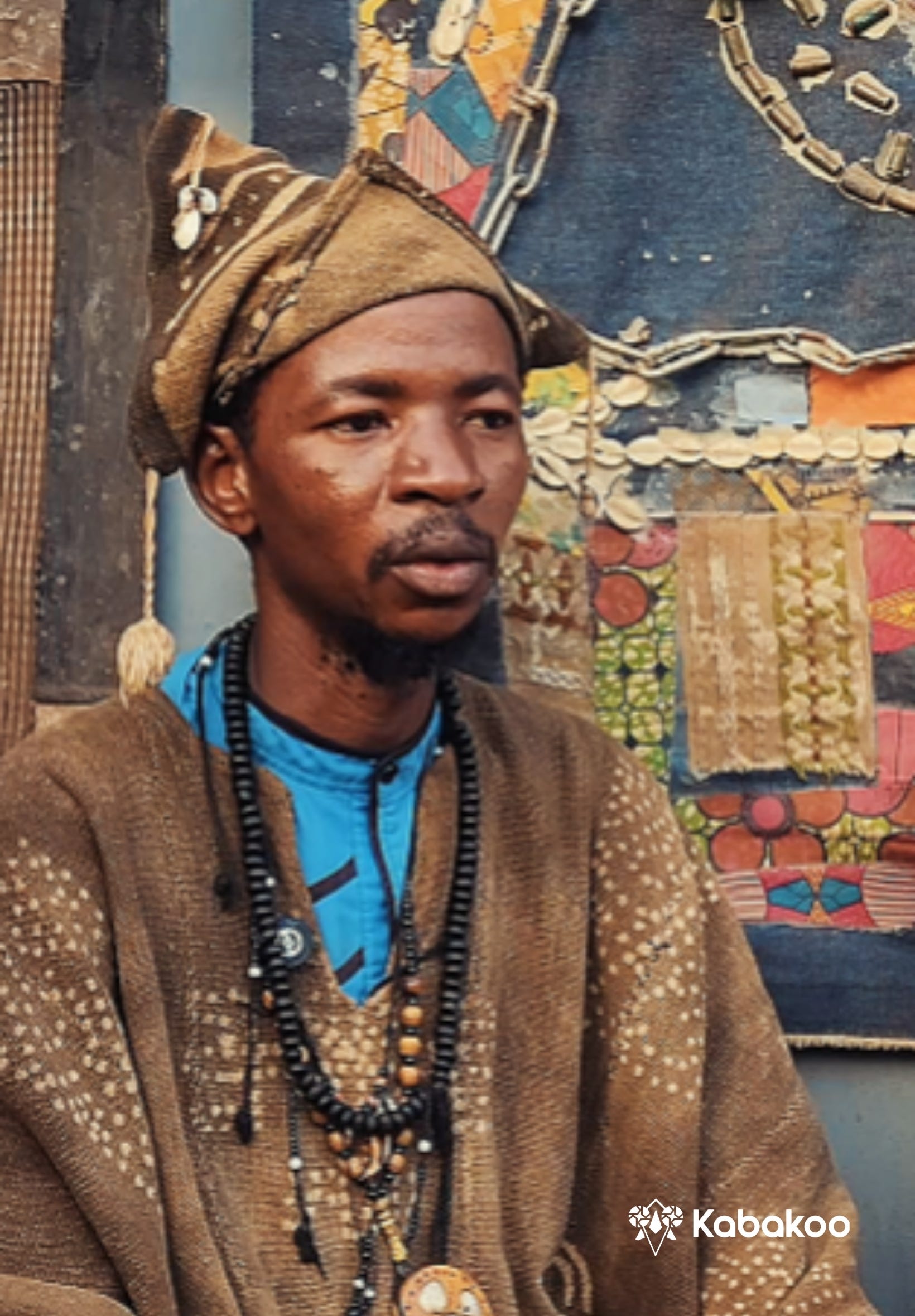
Then the engagement exploded. Hamadoun Témé, a visual artist who turns discarded materials into contemporary Dogon expression, passed 133k unique viewers on a single video. Noumousso Kané, a master potter whose clay technologies still solve real problems of cooling and storage, reached more than 100k. Samaou Touré, a master weaver from Gao reached 766k impressions with a single written post and no video at all. Of course, all this social media performance is purely organic, no ads.
Master Potter Noumousso Kané, Master Artisan Hamdoun Témé, and Master Weaver Samaou Touré in their respective workshops.
×
The easy reading is that people like tradition. But looking at the comments and questions we received about the videos and during the subsequent events, what links these three is really problem-solving. Hamadoun turns waste into value. Noumousso applies generations of material knowledge to today’s constraints, and so on. None of them are preserving the past. They create economic value in the present, with whatever is around them, and audiences see themselves in that. The point of our Highdigenous work is to widen the pool of knowledge a young person counts as a legitimate place to start when building something.
AI is everywhere. What about belonging and social connection?
Some of you might remember the powerful learning we shared in our 11/2024 update. We’d run a small, slightly nervous experiment: we offered selected applicants a scholarship but asked them to pay a 20,000 FCFA (USD33) registration fee to confirm their place, the way local private training centers do in Bamako. Less than 20% paid. As we admitted at the time, that was “a real blast on our ego.” But it handed us some unusually clean behavioural data, so we put a simple question to it. What makes a young Malian actually invest in a Kabakoo training?
It wasn’t their economic activity. It wasn’t their parents’ occupation, their gender, their education, their age, or their internet access. It wasn’t even their optimism about the future. The factor that stood out was their prior engagement with the Kabakoo community, and above all whether they already had friends inside it. Even more surprising for us, the people who paid scored lower on growth mindset, on average, than the people who didn’t. The idea came back to us in our 05/2026 edition, where our dropout remediation work kept showing that the learners drifting away were the ones who hadn’t interacted with anyone else connected to the training.
In the last weeks, two fresh analyses enriched our understanding of the issue.
First, we learned that the learners who’d had an in-person touchpoint (through workshops or peer club sessions) engaged far more with the digital part of our WhatsApp-based upskilling tool. This analysis isn’t ours, and that matters to us, for reasons we’ll come back to.
Elia Gandolfi, Data Scientist and Product Lead at The Agency Fund, took an independent look at the data from a current cohort of 826 learners going through our WhatsApp Upskilling System. The first sobering information is that 412 of them, almost exactly half, never took a single action.
A key insight is that the 73 learners who had at least one in-person touchpoint (workshop or peer session) looked like a different population from the 341 who stayed digital-only. On average they sent four times as many messages to the AI Mentor, and watched 48 times as many module videos. The gap is large and very unlikely to be chance (Mann-Whitney p < 0.001, r = 0.52).
Compared to the 341 digital-only learners, learners who attended any type of in-person sessions sent 4× more messages and watched 48× more module videos on average. Source: Elia Gandolfi, The Agency Fund.
Second, we asked ourselves what really separates our most active learners from the rest. We compared the most active learners in our latest cohort against the least active. Grit. Growth mindset. Self-efficacy. None of them separated the two groups in any meaningful way (growth mindset came back at p = 0.706, self-efficacy at p = 0.757, grit at p = 0.963). Digital and AI literacy didn’t either. Actually, a couple of our most active learners started with some of the lowest digital-literacy scores in the sample, and the less-active group actually reported higher AI literacy on average.
What did separate them was prior connection to Kabakoo. Among high-activity learners, 48% had already used the Kabakoo app, against 15% of the low-activity group. 64% identified as part of the Kabakoo community, against 39%. 18% had taken a Kabakoo course in the previous six months, against 3%. The same prior-connection signal that predicted who would pay in the 2024 experiment now predicts who shows up in 2026.
A quick caveat: These are comparisons between two groups, not controlled experiments. For instance, we can’t say the in-person touchpoint caused the engagement. Maybe the already-driven learners are simply the ones who turn up. But the traits that would carry that story are the same grit, self-efficacy and mindset that didn’t separate our active learners from our inactive ones.
So now, we are intentionally integrating a short warm-up period in the cohorts and keeping structured human touchpoints early. As the blog published in July 2019 shows, we had the right intuition since the beginning, but we suspect we’d been underbuilding the social brain all along.
How the language of an AI tool influences what becomes thinkable: Analyzing 11,171 bilingual conversations in our AI-learning system
Bambara has become a steady part of how learners talk to the Kabakoo AI mentor. Usage kept climbing month after month, and interaction volume grew faster than the number of users, which means people weren’t trying it once and slipping back to French.
The more interesting finding was that most of them weren’t choosing at all. Roughly 77% of learners who used Bambara also used French, moving between the two depending on what they were trying to do. Also, text stayed overwhelmingly French, while nearly 40% of voice interactions happened in Bambara.
We saw the same thing during our TVET digitization project in 2024. Learners wanted oral explanations in Bambara, but 92% reported difficulty reading it, and half couldn’t read it at all. For written content, they preferred French.
It echoes what we first flagged a year ago. Conversations in Bambara focused on entrepreneurship, endogenous knowledge, and local culture; conversations in French focused on digital and technical content. Endogenous knowledge and culture-related topics were roughly twice as frequent in Bambara (10.5%) as in French (5%); digital-tech topics were four times more frequent in French (13%) than in Bambara (3%). The same population of learners, the same AI system, but different language leading to different knowledge surfacing. Language hence doesn’t just provide access, it changes what becomes thinkable.
(With over 42,882 registered learners, each month we spotlight a member of our vibrant community.)
Meet Fadilatou A., learner at Kabakoo.
After high school, Fadilatou chose chemistry. She genuinely liked it but struggled to stay motivated since she could not envision her future.
“At the end of the day, I often felt like I hadn’t accomplished anything. It made me sad, because we had dreams and things we wanted to achieve, but we couldn’t see how we were going to get there. The future felt blurry.”
Looking for something else, she found Kabakoo through our upskilling program on XR technologies and regenerative architecture, two things unlike anything she’d done before. With Kabakoo, she discovered a different way of learning, one that asked her to experiment and to say what she thought out loud in her phone camera. For someone shy, who rarely spoke up, that changed things.
The turning point came through Kabakoo’s Maker in Residence program, where she joined a team working on AI-powered 3D animation. The group showed its work at the SENUMA, Mali’s national Digital Week, using new tools such as Google Flow or Runway to tell stories rooted in Malian heritage and endogenous knowledges.
“Through these animations, we can better understand who we are, highlight our realities, our culture, and the things we are passionate about.”
The future doesn’t feel blurry to her anymore.
“Today, I’m much more comfortable imagining the future, because I have something I’m developing, something I’m growing in, and something I genuinely love.”
We’ve been building AI for West African youth since 2019. For years almost nobody outside our community saw it.
And honestly, we fell short of adequately explaining ourselves. Still, other people started doing the explaining for us. After featuring Kabakoo as one of 16 “Schools of the Future” worldwide, back in 2020, The World Economic Forum featured Kabakoo as one of only nine case studies pioneering the use of AI for learning in 2024. More recently, The WEF’s June 2026 report,Shaping the Future of Learning: Education Readiness for the Age of AI, names us among the experts whose input informed it. Reading it, you will recognize Kabakoo’s approach in topics such as localized relevance, learner agency, and structured community engagement. Moreover, thanks to our groundbreaking work, Yanick has been invited to join the Steering Committee of Real ML, one of the world’s premier convenings on AI accountability and algorithmic justice.
To operate both conceptually and implementation-wise at the global frontier of such a fast-moving field as AI and the future of upskilling, for more than half a decade, from our offices in Mali and Togo, is quite a headline.
And we have achieved that precisely by being committed to continuous and open learning. Academic researchers from Paderborn University ran a randomized study built on our data. And, as you read above, behavioral and data scientists at The Agency Fund went through our data independently and even surfaced patterns we had never measured ourselves.
So, if you are in rooms that should see it, if you know executives in public agencies and multilateral organizations focused on human capital, or funders who invest in what’s happening at the frontier of AI and human flourishing, please send them our way.